
A Breakthrough for Patients: 25 Year Anniversary of Innovation in Treating CML

Twenty-five years ago, Novartis pioneered a paradigm shift in cancer care with the introduction of the first tyrosine kinase inhibitor (TKI) for chronic myeloid leukemia (CML), transforming it from a deadly disease into a chronic condition for most patients. This breakthrough helped lay the foundation for targeted therapies in oncology and continues to shape the future of CML treatment today.

Sep 15, 2025

Twenty-five years ago, Novartis scientists ushered in a new era in cancer treatment—one that redefined treatment for people living with chronic myeloid leukemia (CML). 

Once considered a life-threatening illness, CML is a rare form of cancer that originates in the bone marrow—the tissue responsible for producing blood cells. It occurs when the body produces too many abnormal white blood cells, disrupting normal blood function.1 While the condition remains serious today, people diagnosed with CML can now typically have a normal lifespan.3

This change was fueled by visionary researchers, clinicians, and courageous patients. Thanks to their dedication, the CML community has had the opportunity to benefit from the tyrosine kinase inhibitor (TKI) ever since.
What Is a TKIand How Has It Changed Treatment for CML

TKIs are a type of targeted therapy that treats CML by blocking abnormal tyrosine kinase enzymes that are stuck in the "on" position. These enzymes send constant signals that cause cancerous cells to grow uncontrollably. By switching these signals "off," TKIs stop the excessive cell growth and help restore normal blood cell production.2

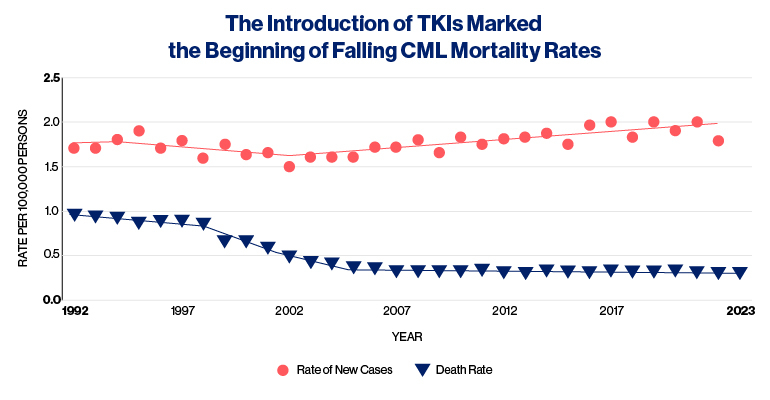
CML Mortality Rates Chart
Adapted from National Cancer Institute; Cancer Stat Facts: Leukemia — Chronic Myeloid Leukemia (CML).3

The difference TKIs have made is immense. Even though the rate of people being diagnosed with CML has increased, the rate of people who have died from the disease has declined by more than half since the advent of this treatment. For patients, this progress means that with the right treatment plan and consistent monitoring, it’s now possible for many to have a normal lifespan.3

Twenty-Five Year Anniversary of Innovation: How a Practice-Changing Treatment Was Created

It's been 25 years since the introduction of the first TKI. Since that time, technology has certainly advanced—you can now stream Netflix and Hulu, summon a ride through Lyft or Uber, and use contactless payments. The paradigm shift for patients with CML has been no less profound as a result of this new treatment.

CML_BloodCAM_TKI Anniversary_Animated Timeline Video VIDEO


The technological developments of the past 25 years mirror the advancements made in CML treatments. In the past, therapeutic options were limited to drugs such as interferon-alpha, hydroxyurea, cytarabine, or bone marrow transplant.But TKIs introduced a new way to treat CML through a more targeted approach. TKIs were their own revolution, creating a profound innovation in how cancers are treated now. 

I couldn’t be more proud of the work Novartis has done to bring in the voice of the community as we continue to drive innovation in CML.

- Rodney Gillespie, US Head, Oncology

"If there’s one thing my experience working with the CML community has taught me, it’s that we are determined, supportive, and always working together, striving to improve the patient experience,” says Rodney Gillespie, US Head of Oncology at Novartis. “And this story mirrors that of TKIs, which have impacted so many people. I couldn’t be more proud of the work Novartis has done to bring in the voice of the community as we continue to drive innovation in CML.” 

Twenty-Five Years of Community: How Living With CML Has Changed—and Brought Patients Together 

CML Leadership Summit LinkedIn Photo
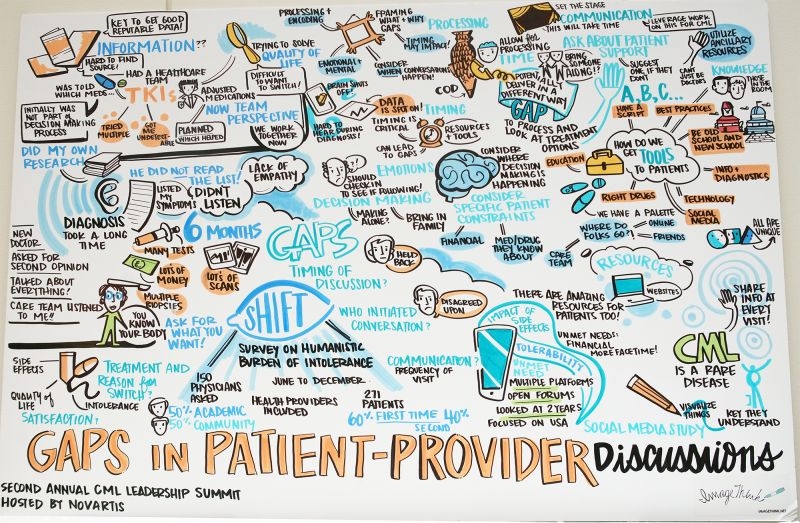
Discussion notes from the Second Annual CML Leadership Summit hosted by Novartis

Over the last two decades, patients' needs drove continued innovations in TKI therapy for CML treatment. Social media emerged as a vital space where patients and caregivers could share experiences, learn from and support each other. This level of engagement has reshaped what it means to live with CML since the turn of the century. 

The CML patient advocacy community has played a vital role in helping those living with this disease—as well as their families and loved ones—to find support, resources, and connection. 

Collaboration among advocacy groups, patients, health care teams, and all those involved in delivering and supporting care is what truly drives best practices for improved patient care, better treatment decisions, and meaningful progress. 

- Joannie Clements, a CML patient and VP of Mission at CML Buster Foundation

“It is vital for patients like myself to have the tools and courage to make our voices heard and ask for what we need,” says Joannie Clements, a CML patient and VP of Mission at CML Buster Foundation, “Collaboration among advocacy groups, patients, health care teams, and all those involved in delivering and supporting care is what truly drives best practices for improved patient care, better treatment decisions, and meaningful progress."

Further reinforcing this collaboration, Novartis has remained deeply committed to supporting the CML community through long-standing partnerships, global initiatives, and collaborations with patient advocacy groups. 

Last year, we launched the first-ever CML Leadership Summit to discuss the challenges and burdens of living with CML. The platform, led by our patient advocacy and medical teams—is designed to help bring together physician and patient group leaders to improve shared decision-making and address communication gaps and barriers between patients and their health care teams. 

In 2001, we partnered with The Max Foundation to implement the first direct-to-patient global treatment access program. The following year, in 2002, Novartis supported the first New Horizons conference, now called CML Horizons, helping bring together patient advocates and laying the foundation for international collaboration.

Since the beginning, Novartis has been a steadfast supporter of patient advocacy groups such as the CML Buster Foundation and Blood Cancer United, formerly The Leukemia & Lymphoma Society (LLS), through sponsorships, supporting walks, and more. 

These collective efforts reflect our ongoing commitment to improving clinical practice for people impacted by CML. As patient needs evolve, Novartis remains dedicated to advancing innovation and strengthening collaboration. Looking ahead, we aim to build on 25 years of progress to help meet future challenges and continue supporting the CML community.

References:

  1. Mayo Clinic. Chronic myelogenous leukemia. Accessed August 5, 2025. https://www.mayoclinic.org/diseases-conditions/chronic-myelogenous-leukemia/symptoms-causes/syc-20352417
  2. Cleveland Clinic. Tyrosine Kinase Inhibitors. Accessed August 5, 2025. https://my.clevelandclinic.org/health/treatments/24984-tyrosine-kinase-inhibitors
  3. National Cancer Institute. Cancer Stat Facts: Leukemia — Chronic Myeloid Leukemia (CML). Accessed July 15, 2025. https://seer.cancer.gov/statfacts/html/cmyl.html
  4. Yilmaz M, Abaza Y, Jabbour E. Selecting the best frontline treatment in chronic myeloid leukemia. Curr Hematol Malig Rep. 2015;10(2):145–157. doi: 10.1007/s11899-015-0254-5