

Tina Aswani Omprakash’s hospital bedside table was crowded with an unusual collection of items she regularly used to combat dryness throughout her body: Eye drops, nasal moisturizers, mouth hydration solutions and vaginal creams. It was this array of products that caught Tina’s gastroenterologist by surprise when he checked on her during her recovery from surgery.
"[My gastroenterologist] looked at my table and said, 'Wow, what is going on over there? This is not what I typically see on a patient's table," Tina recalled. "And I thought, 'OK, this is weird, but sure, let's talk about it.'"
That chance observation led Tina to a referral for a rheumatologist and ultimately, to a diagnosis of Sjogren's disease, a systemic autoimmune disease that causes debilitating symptoms affecting the whole body.1 Nine out of 10 people diagnosed with Sjogren’s disease are women, but Sjogren’s can be diagnosed in people of any age, sex or ethnicity.2
Sjogren's is a disease that affects our ability to work or go to school. It affects our ability to function in society.
At 38, after years of managing numerous health issues, this new diagnosis was both jarring and clarifying. Tina didn’t even know what Sjogren's was, but she was relieved to finally have an explanation for her symptoms.
What Is Sjogren's?
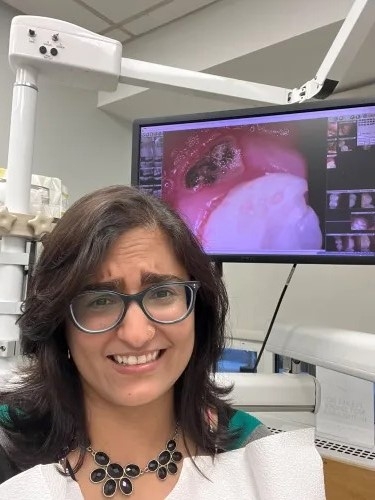
Sjogren's disease is a chronic autoimmune disease which causes the immune system to attack the glands that make moisture in the body.1,4 It is often defined by dryness of the eyes, mouth, skin and vagina, which can be easily dismissed as trivial.5,6 However, Tina emphasizes that the disease is far more severe than many realize. The gravity of her condition became clear when she nearly visited the emergency room multiple times due to extreme vaginal dryness.
“The experience is miserable,” she says. “Sjogren's is a disease that affects our ability to work or go to school. It affects our ability to function in society."
But for Tina, the impact of the disease on her dental health was the most surprising. "The dental issues are unreal," she said. Despite being cavity-free until the age of 24, she now develops multiple cavities every 6 months due to the impact a lack of saliva can have on tooth decay and oral infections.
Obtaining an accurate diagnosis and treatment for Sjogren's can be a challenge.7 There is no singular test for the disease, and a lack of awareness and clarity, coupled with symptoms that overlap with those of other conditions, often makes it difficult for patients to get accurate answers about what they are experiencing.6
Your health deserves to be taken seriously," says Tina. "Be persistent. Be informed. And remember that you are the expert on your own body.
“I've had to read up on every condition that I have, do the research, and learn the jargon in order to be taken seriously,” said Tina. "I wasn’t even aware that my symptoms were something I needed to flag.”
Cultural barriers can further complicate the journey. This was the case for Tina, who is of South Asian descent. “There is a phrase in Hindi and in Urdu — log kya kahenge — which means ‘what are people going to say?’” says Tina. In her experience, little-known diseases like Sjogren's are often viewed as insignificant and discussing it could negatively affect family reputation.
Despite all of the challenges presented by the disease, working with a rheumatologist to address her symptoms has helped improve Tina's quality of life.
"I’ve seen real progress," she said. "After 16 years of being on disability, I've been able to start working again."
Turning a Corner: How Tina Is Enabling Others to Get Help

Tina has since founded a patient advocacy organization and rebuilt her career after earning a master's degree in public health. Though she still faces daily challenges—carrying numerous medications and dealing with seasonal flares—she has reclaimed meaningful parts of her life.
For those experiencing unexplained dryness or other symptoms common with Sjogren’s, such as extreme fatigue and joint pain, Tina's story highlights the importance of seeking proper medical care and sharing your symptoms with a healthcare professional. Early consultation with a rheumatologist who specializes in Sjogren’s can lead to better management of the disease.8
Though her career path wasn't what she originally envisioned, Tina has found purpose in her experience. "Sometimes what looks like a detour becomes your most meaningful direction," she says. "My advocacy work has connected me with a community that truly understands me."
As she continues building awareness of Sjogren's, Tina remains a powerful testament to the difference one voice can make—starting by advocating for yourself.
"Your health deserves to be taken seriously," she says. "Be persistent. Be informed. And remember that you are the expert on your own body."
Novartis is committed to engaging with and listening to the Sjogren’s community to raise awareness of the disease and make a meaningful difference for patients. Learn more about Sjogren's disease.