Colin works in San Diego, where we've recently broken ground on a new, state-of-the-art global Biomedical Research center to accelerate drug discovery, part of the $23 billion US investment Novartis announced last year.
That center will further support our researchers with world-class scientific infrastructure and drug discovery capabilities, serving as a gateway for even greater collaborations with the thriving and dynamic California life sciences ecosystem.
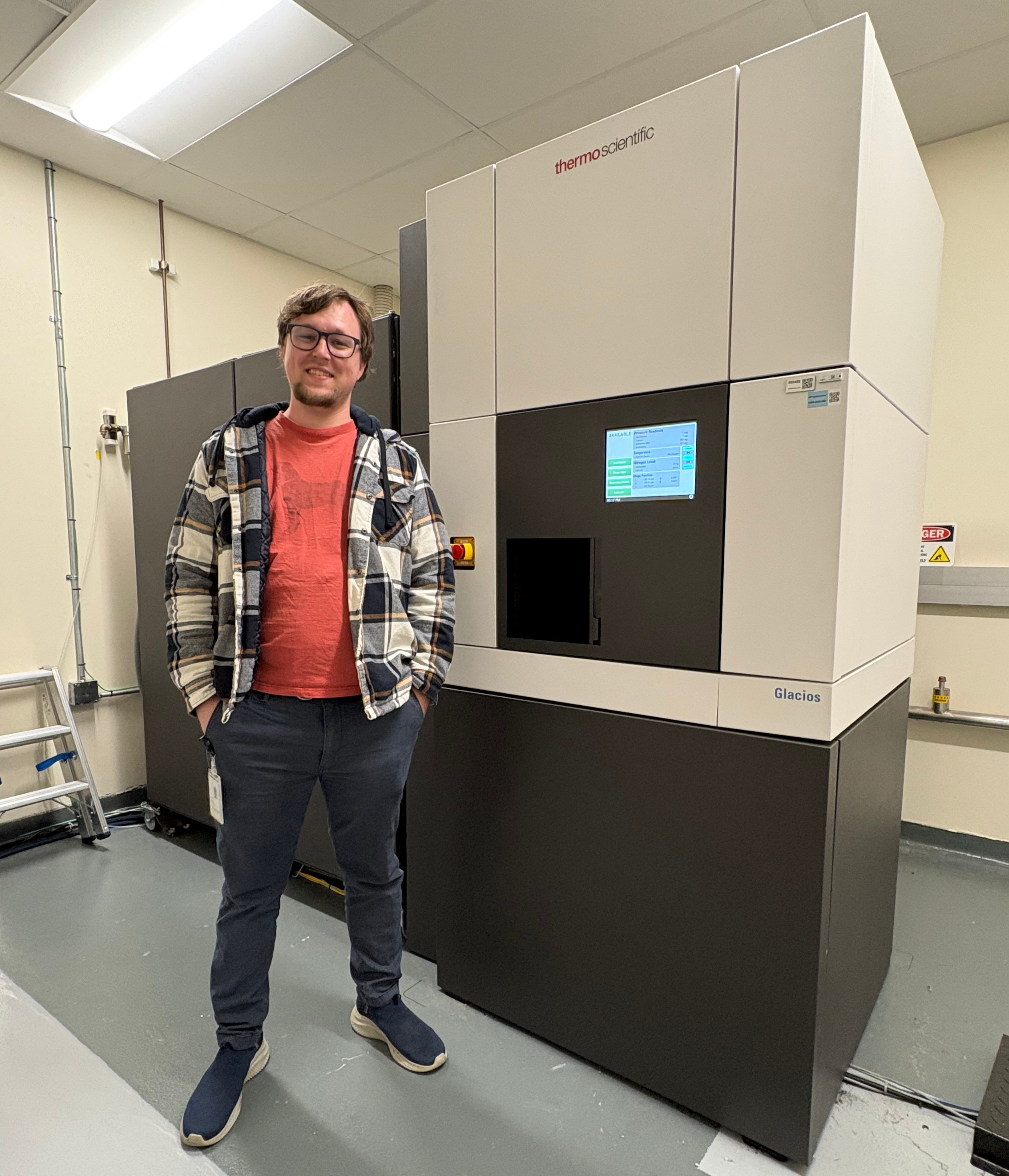
Colin is a Principal Scientist II on our structural biology team in San Diego. He is using groundbreaking technology — a cryo-electron microscope—to learn, understand and catapult our scientific understanding.
The development of cryo-electron microscopy earned three scientists a Nobel Prize in Chemistry in 2017. The novel technique simplifies and improves the imaging of biomolecules. Imagine turning something invisible into something you can actually see: That’s what Colin does every day.
He helps take incredibly complex science and makes it visible, revealing how medicines can interact with a disease and open new possibilities to improve patient outcomes.
Q: What’s your superpower that enables you to see the invisible?
A: To make this possible, we use one of Novartis’ cryo-electron microscopes. This advanced technology captures thousands of images and stitches them together into a 3D model that allows us to see how compounds interact with proteins relevant to certain diseases. When those images come into focus, new insights emerge.
It’s this visibility we gain with the microscope that is science in motion—offering us insights that ultimately allow us to potentially discover the next breakthrough.
- Colin Deniston, Principal Scientist II, Novartis US
"Not only do we get to see science in a new way, we can also feel the possibility of what it can mean for patients and their families," he shares. "We then take what we learn from the microscope to make decisions that move our science forward. It’s this visibility we gain with the microscope that is science in motion—offering us insights that ultimately allow us to discover the next potential breakthrough."
Every day, I get to advance science, one image, one model at a time.
Q: The new San Diego facility is part of the large investment Novartis announced last year in the United States. Tell us what this means for patients and the community.
A: I like to think that there are a lot of us here in San Diego with superpowers. It takes a team of scientists and pretty cool technology to take what we learn from the cryo-electron microscope and advance an idea to the next phase of research.
Learn more about Cryo-Electron Microscopy, or CryoEM
Together, we are all working toward the same goal: Find the next scientific advancement. And, as our new facility here gets built, we’re excited to see how the new labs and latest technologies will give us the opportunity to be able to unlock even greater possibilities.
I feel really lucky to be at the center of the future of science.
Q: We’re on a mission to redefine our role in healthcare. How do you see the work you’re doing contributing?
A: In our labs, every day we’re stepping into the unknown and building something new. How we advance research today seemed like science fiction not too long ago. Now, we get to be not just science-curious, but also technology-curious.
At the end of each day, I like to think that what we’re doing isn’t just creating a model—it’s seeing the direct link between this work and the potential difference it can make for patients, families and communities.
By using state-of-the-art technology, like the cryo-electron microscope, we, as scientists, get to learn and experiment in new ways. It helps guide our thought process and decision-making. If we didn’t have cutting-edge technology or state-of-the-art lab environments, I wonder what we would miss or what would take twice as long to discover.
At the end of each day, I like to think that what we’re doing isn’t just creating a model—it’s seeing the direct link between this work and the potential difference it can make for patients, families and communities. Using our human superpowers and the latest technology to unlock something that didn’t exist before is incredibly energizing.
When you stay curious and keep exploring, you can find the scientific advancements that may shape the future of biomedical research.
Q: Finish this sentence: “The future I’m helping build here is …”
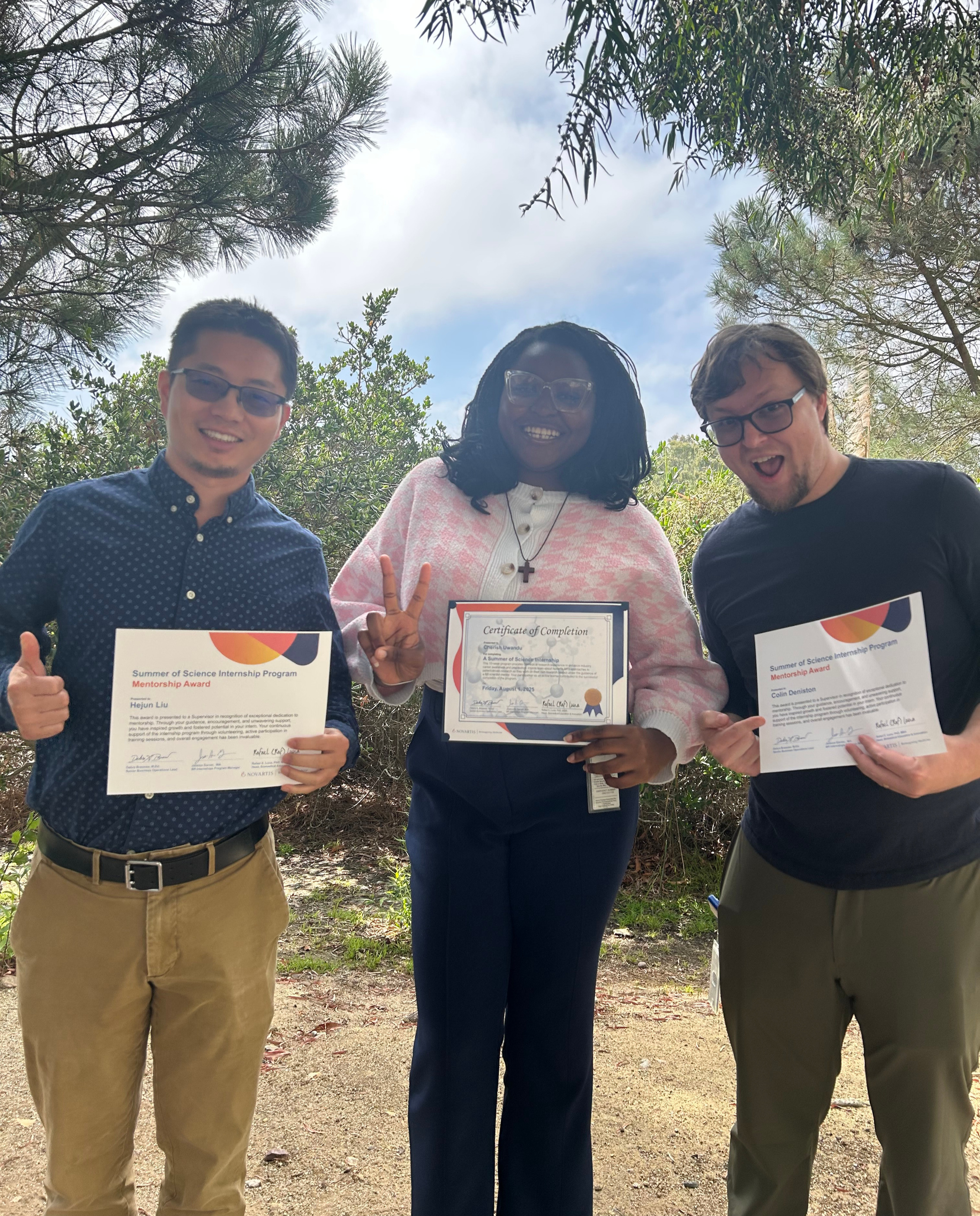
A: Helping the next generation of scientists. Advancing science isn’t just what we can achieve in our labs today.
Through the Novartis Young Scientist Outreach Program (YSOP), I’ve had the privilege to connect colleagues with university students who want to learn about careers in science and industry. Here on the West Coast, we partner with colleges in San Diego and the surrounding area to match students with mentors—those who can offer advice on grad school, build a compelling job application, and share what a day in the lab really looks like.
Also, every summer I’m always amazed by the curiosity and energy that our Novartis Summer of Science interns bring to our work. Seeing them experience the labs fuels my own passion for discovery.
Thank you, Colin, for sharing more about your role at Novartis.
Take a look back at a legacy of our biomedical research breakthroughs that trace their roots to our San Diego site.


