
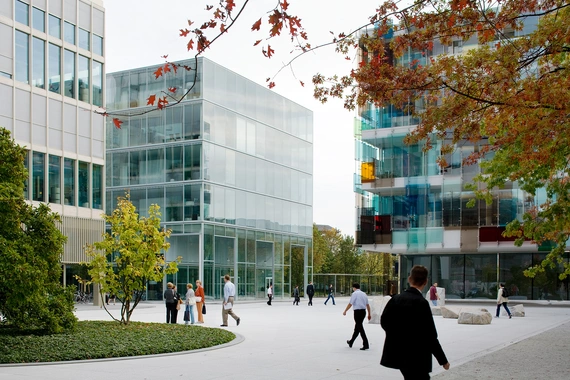
Report on Nonfinancial Matters 2025
This report covers information on nonfinancial matters deemed material and in scope of our reporting obligations under the Swiss Code of Obligations (SCO), as well as our due diligence and reporting obligations in relation to child labor under the SCO.
It includes our Human Rights Statement addressing specific jurisdictional requirements for disclosure on modern slavery, decent work, forced labor and child labor.

Annual Social Impact and Sustainability investor event
Our 12th annual Social Impact & Sustainability investor event provided updates on the impact we continue to deliver through inclusive access to innovation and environmental sustainability.
View the event presentation (PDF 2.1 MB)
For more recent progress, we provide a quarterly impact and sustainability update.
Q2 2026 Impact and Sustainability Update (PDF 1.2 MB)
Q1 2026 Impact and Sustainability Update (PDF 1.6 MB)
Q4 2025 Impact and Sustainability Update (PDF 1.0 MB)
Q3 2025 Impact and Sustainability Update (PDF 0.8 MB)
ESG strategic priorities
Building trust with society is a key part of the Novartis corporate strategy and is critical to delivering on our purpose of reimagining medicine to improve and extend people’s lives. Our ESG efforts are integrated across the company and are key to driving long-term sustainable value for our stakeholders.
We believe our inspired, curious and unbossed culture will drive better performance. ESG topics form a core component of how the Novartis Executive Committee and the Board of Directors evaluate long-term performance of the company. We are committed to reporting transparently on these topics through our Reporting and Transparency Hub, which includes the Report on Nonfinancial Matters (PDF 1.0 MB), as well as our other publications.

Access
We are committed to expanding access to our medicines globally, working with our partners.

Ethics, Risk and Compliance

Environmental Sustainability

Inclusion
We aim to conduct business responsibly wherever we operate with a focus on building a strong ethical foundation, respect for human rights, patient health and safety, inclusion and the safety and well-being of our employees. We have clear commitments on many other social topics including the living wage, product quality and use of animals in research.
Corporate governance
Our corporate governance framework supports sustainable financial performance and long-term value creation and is aligned with our values and behaviors. In a rapidly changing business environment, we apply effective risk management to build resilience. We continue taking important steps to integrate our ESG agenda into the core of our business, enhancing executive accountability and measuring our performance against transparent targets. Members of the Executive Committee and other senior leaders have ESG targets in their annual objectives.
Transparent reporting
Transparent reporting has been a central part of our commitment for many years and we continue to make progress in this area.

Environmental, Social and Governance (ESG) Index
Our ESG index provides an overview of various topics of interest to investors, analysts, and other stakeholders. We aim to report comprehensively and transparently on our actions, objectives and progress. The ESG index also shows where disclosures can be found across our publications and website.

Reporting and transparency hub

Positions on key topics

Awards & recognition

ESG rating performance

Water project revives rural community in India
Novartis is aiming for water neutrality in our own operations by 2030. In India, we are contributing to this goal through a project near Hyderabad with a nonprofit organization. By tackling both water scarcity and the deprivation it causes, the project has revived the community.

A partnership against epilepsy
Parts of Cameroon have rates of epilepsy that are among the highest in the world. Despite the availability of effective therapies, poverty, a lack of medical resources and superstition about the causes of epilepsy often lead to inadequate treatment and social exclusion for people living with the neurological condition. Novartis is working with a Catholic mission on the ground in a central part of the country to overcome these barriers and improve care.
Novartis is a global company and its policies and programs, including those described in the Novartis in Society Integrated Report, may differ depending on the jurisdiction in which it operates. Novartis is committed to complying with the law in the countries and jurisdictions in which it conducts business.